

Blued Trees Symphony
The Blued Trees project began in 2015 with a symphony. It is now an opera-in-progress called ‘Blued Trees, An Opera’.
The project has received support from the Pollock Krasner Foundation and from the New York State Council for the Arts.
Blued Trees Symphony is a spatial and acoustic outdoor installation across North America, embodying trigger point theory. The installation covers many miles of proposed pipeline expansions, exploring how art, science, and law can change environmental policies about fossil fuels. The installation is composed of trees marked with a painted vertical sine wave. Each marked tree is GPS located, indicating an aerial musical score for an overture. Using copyright law, the artwork on the trees is protected, subsequently protecting the land from eminent domain takings for pipeline development.
The Blued Trees Symphony launched on the Summer Solstice, June 21, 2015, with an overture in Peekskill, New York. It is now installed in many miles of proposed pipeline expansions. Each 1/3 measure of those miles have been copyrighted for protection as a single work of art. Variations of each movement are based on an iterative score created for the overture. All installations are created at the invitation of landowners. The overture was accompanied by an international Greek Chorus at a total of twenty sites internationally. Individual trees were painted and musical variations of the score were performed to echo the theme of connectivity to all life. The score is simultaneously spatial and acoustic and concluded with a coda, a final movement that recapitulated and resolved previous formal themes, on the American presidential Election Day, November 2016.
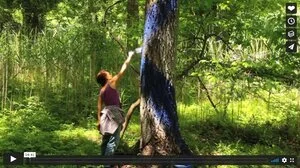
The Peekskill site for the overture was chosen because the pipelines would pass 105 feet from the infrastructure of the failing Indian Point Energy Center, a nuclear facility thirty miles from New York City. The score corresponded to a pattern that would have prevented the movement of heavy machinery. The paint for each vertical sine wave is a casein slurry of nontoxic ultramarine blue and buttermilk that grows moss (based on a Japanese gardening technique).
Links
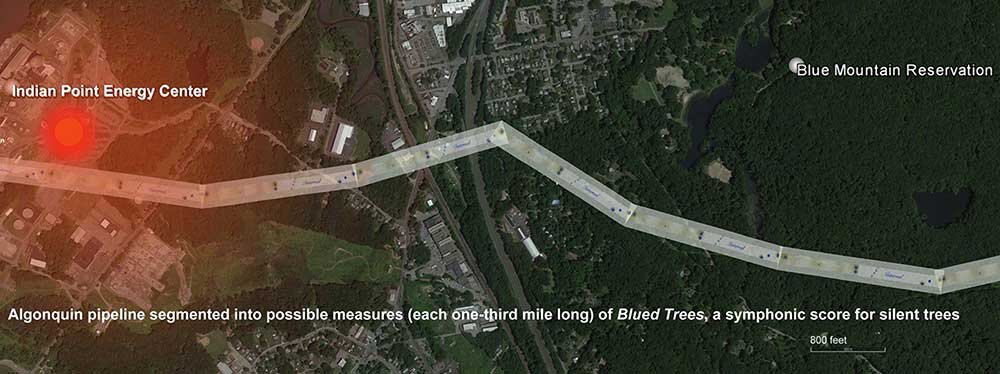
Musical line of the overture for the Blued Trees Symphony Date: June 2015 Size: variable Materials: photoshop Description: The Algonquin (AIM) pipeline that was the subject of the Blued Trees Symphony. The overture was conceptualized as iterated measures of the score from the Blue Mountain Reservation to the infrastructure for the Indian Point nuclear facility, indicated in red to the left of the image, within 105’ of the pipeline. The corridor extends West under the Hudson River, and North and East across the remainder of New England. Aviva Rahmani with Daisy Morton.

Blued Trees Symphonic Score for a Forest Date: Composed 2015 Size: 1/3 mile of tree-notes Materials: Aerial map-score of the distribution of trees designated in woodlands for painting as tree-notes with a casein slurry of buttermilk and non-toxic ultramarine blue pigment. Description: The synesthetic pattern of each 1/3 mile “measure” of the symphonic musical line was designed as both a melodic refrain and to prevent the passage of heavy machinery in increments of 1/3 mile . The score was iterated, with variations based on terrain, at every site and with various instruments. Submitted as part of the copyright material to register the ,Blued Trees Symphony.Composed and mapped by Aviva Rahmani.

Bass Notes, Blued Trees Symphony Detail 3 Location Oneida County, New York Site 1 Date: October 2015 Size: Detail of 1/3 mile measure Materials: Trees painted with a casein slurry of buttermilk and non-toxic ultramarine blue pigment designed to grow mosses. Description: Detail of Blued Trees installation of the first symphonic movement of Blued Trees, on the second of three sites in Oneida County, New York, location of proposed Dominion New Market pipeline. Photo by Aviva Rahmani.

Blued Trees November 9 Detail 4 Date: 2015 Size: 1/3 mile Materials: Trees painted with a casein slurry of buttermilk and non-toxic ultramarine blue pigment designed to grow mosses. Description: detail of tree-notes from Blued Trees overture as seen Nov. 9, 2015, after submission of cease and desist notice to the Algonquin and Spectra pipeline corporations and in-plead to the court to protect the registered copyright on the overture. Photo by Erik McGregor.
Please donate to Blued Trees as we continue our fight against ecocide.
Publications
Denson, Roger. “Earth Day EcoArt Confronts Deforestation, Fracking, Nuclear Hazards In Eastern US Woodlands,” Huffington Post online publication available at: http://www.huffingtonpost.com/g-roger-denson/earth-day-ecoart-confront_b_9721354.html April, 21, 2016.
Williams, Wes. “Landowners Put Hope in Art Project to Combat Pipeline,” WVTF.org online publication available at: http://wvtf.org/post/landowners-put-hope-art-project-combat-pipeline#stream/0 April, 19, 2016
Collins, Shay. “Aviva Rahmani’s Blued Trees and the Fight Against Pipelines” The Cornell Daily Sun online publication available at: http://cornellsun.com/2015/12/03/aviva-rahmanis-blued-trees-and-the-fight-against-pipelines/ December 3, 2015.
Rahmani, Aviva. "Blued Trees on the front lines journal excerpts" The Brooklyn Rail online publication available at: November 5th, 2015.
Baumgardner, Julie. “Nine Artists Respond to Climate Change” Artsy online publication available at: September 22, 2015.
Steinhauer, Jillian. "Art to Stop a Pipeline" Hyperallergic online publication available at: September 9, 2015.
Rahmani, Aviva. “Blued Trees” CSPA Quarterly Issue 12, August 3, 2015.
Bogok, Gusti. “Art and Activism: The Blued Trees symphonic movement to put ‘public’ back in ‘public benefit’” readersupportednews.org online publication available at: http://readersupportednews.org//index.php?option=com_content&task=view&id=32089 August 28, 2015.
Clarity. “’Blued Trees.’ Art to Stop a Pipeline?” Sane Energy Project online publication available at: July 26, 2015.
Background:
Lost & Threatened Plants and Animals
Species biodiversity is important to preserve resilience for the health of the planet, its ecologies, and human life. Pressure from human activities is causing an ever-accelerating threat to many different species of plants and animals. The giant panda or the polar Bear may be the most emblematic of critically endangered animals in the popular imagination, but many other charismatic animals are endangered by anthropogenic activities such as the blue macaw, Sumatran tiger, green sea turtle, spotted owl, and California condor. Still, they are only the top of an iceberg that includes countless insects critical to pollination as well as many other mammals and plants that attract less attention and reverence. At the time of this writing, the International Union for Conservation of Nature (IUCN) has assessed 120,372 species of animals and plants and have awarded the status of “threatened” to 32,441 — over 25 percent. The figures of species under threat of extinction are staggering. For example, 25 percent of mammals, 41 percent of amphibians, and 13 percent of birds.
Through many of her ecoart projects, Aviva Rahmani has flagged the crises that life on Earth faces, particularly over the ecosystems that protect both fresh and saltwater, such as estuaries. She confronts the vital importance and interconnectedness of complex roles that different species play in healthy ecosystems. Many of her projects explore how art can catalyse change in the environment and positively impact or even reverse our movement toward plant and animal extinction.
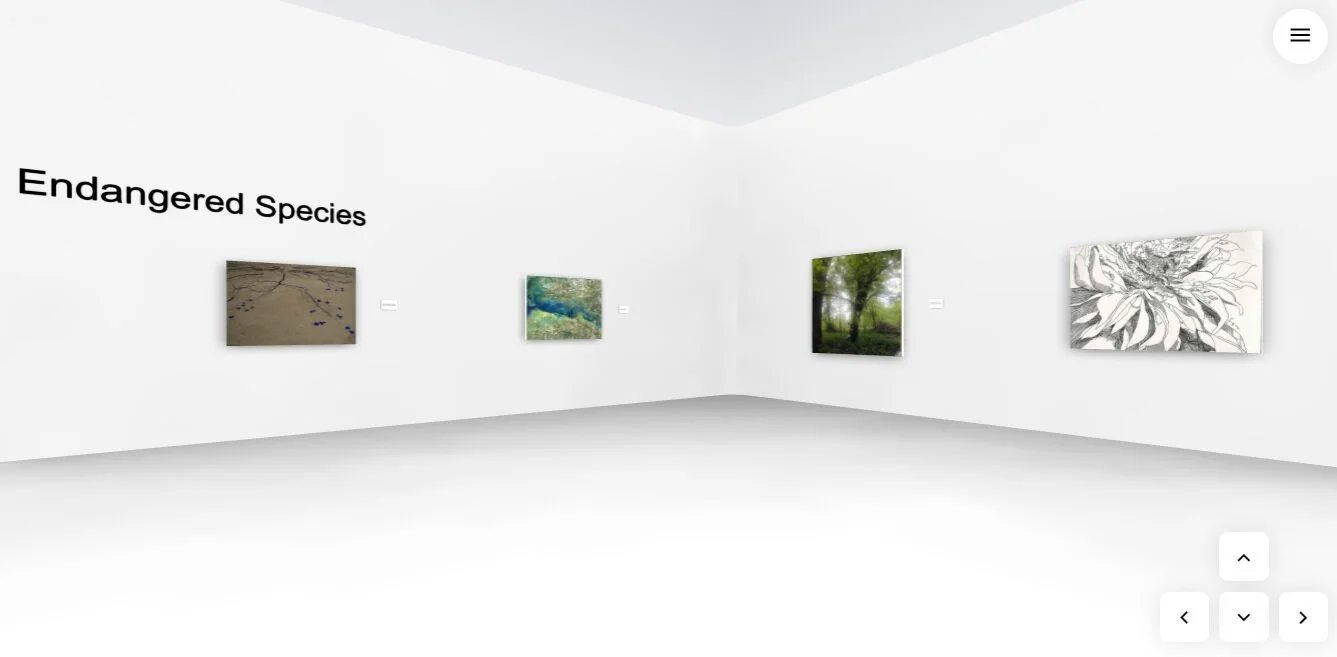
Click the above image to view the virtual exhibition ‘Scenes from a Marriage of Art and Science’.
This exhibition features photographs of installations, drypoint etchings and digital artwork by Aviva Rahmani. In particular these works explore themes of endangered species, water ecosystem preservation and climate change.