
Practical Ecofeminism
Discourse on Art, Women and Feminism edited by Karen Frostig and Kathy A. Halamka, Newcastle: Cambridge Scholars Publishing, p. 315. 2007
This essay introduces a term for and theoretical model for ecofeminism in ecological art practice. The term, "practical ecofeminism," is based on an evolution from an innocent, celebratory relationship to the earth, arguably predicated on feminist essentialism, to a recognition of and layered response to environmental damage done. That narrative unpacks a relationship between human rape, human disturbance of nature, and healing models for both. Practical ecofeminism is the work of artful repair to damaged ecosystems: environmental triage. It manifests theory in works, based on careful observations of natural phenomena. In this text, I will examine my own career to illustrate that story.
Women's bodies have always been sites of land conflict, proxies for political power, and fields of competition for resources and genetic domination. We are particularly revolted today over rape victims in Serbia or the Sudan. Yet, one in four women internationally, and one in seven men, even in peacetime, experience brutal private repression and physical rape that parallels the public experience of rape of natural resources.
The night I was raped by my fiance, there was no blood on my face, as there had been four years earlier, when my father beat me. My mother didn't fly in the door to rescue me in response to my screams. There were no screams. l had learned helplessness in the face of shame and fear. My silence was cousin to the silence in the forest that masks subsonic cries from adjacent trees, when they are felled by clear-cutting, the panicked squeals of livestock led down chutes in slaughterhouses and the melodies of dying songbirds translated for us by Rachel Carson in Silent Spring.1
Women are affected disproportionately, globally by environmental problems.2 Women are usually the family nurturers. When pollution and global warming disrupt growing cycles, deplete water, and sicken the environment, women are first responders to the crisis. But women who challenge powerful men and patriarchal systems over land use and land use policy are especially vulnerable. Women such as, Vandana Shiva,3 Wengaari Maathi,4 and Judi Bari5, who have been in the vanguard of protests against environmental degradation, often become targeted for especially violent reprisals.
How might we remodel the aesthetics of land policy? The answers began taking shape for me as a child in a family of developers. I observed how conventional land development is extractive rather than supportive of healthy ecological diversity. I rebelled against how that work cast my father as hero, my mother as housewife-support victim, all at the expense of cherished ecologies. Family context and feminism would make land and gender-role issues inseparable and personal.
Seventies ecofeminism in art evolved from romantic idealism about goddess worship. It rode a buoyant late-century tide of international reformist political optimism. Liberated by birth control from inevitable pregnancies, women foresaw an eroticized and empowered theoretical future. Despite significant progress and earlier historical warnings, as from the trials of American suffragettes, many of us were unprepared for the decades ahead of infighting within the movement and cultural backlash around it. With several major exhibitions, 2007 emerged as a time to consider a more complex historical analysis of how women artists have been and continue to be culturally effective. But the role of environmentally conscious American women artists was scarcely noted. Yet many of those women, such as Mierle Ukeles and Betsy Damon. have been uniquely effective in addressing the ever-expanding list of human induced ecological disasters.
Early in the century, in Gennany's Bauhaus, experimental artists and movements challenged the social and cultural implication of what was good art. In the sixties in New York City and in the seventies, in Southern California, I was privileged to know and work with many of the seminal crossover thinkers who inherited that mantle, influencing my own work and that of others. They infom1ed and re-invigorated my rigorous classical education in Europe and traditional training in the arts. In the late sixties, there were several people who affected me. Those included the writer Anai"s Nin, arguably a mother of the sexual revolution, and philosopher Herbert Marcuse,6 who analyzed surrealism in the context of merging Freud and Marx. Artists such as Allan Kaprow (father of "Happenings"), John Cage and the Fluxus artists, who introduced Zen chance and ephemerality into art market discourse, were crucial to me as was Peter Schumann of the Bread and Puppet Theatre who worked with ordinary people to merge art and politics and the visionary Billy Kluver whose work with Experiments in Art & Technology (EAT), supported by Bell Labs, revived the tradition of merging art and science that went back to Leonardo DaVinci.
ln 1968, l moved with my then-husband from art schools in New York City to San Diego. As a young artist and activist against the Vietnam War there, I set out to apply my theoretical understanding of the parallels between physiological responses to stress, such as, rape and environmental instability caused by human exploitation to perfonnance work.
The American Ritual Theatre (A.R.T) (1968-71),7 was a group I founded and directed. It led to the communal fanning experiment Synapse Reality (1970). I called this commune an on-going performance event and sculpture, long before I'd heard of Hans Haacke or Joseph Beuys' "Social Sculpture" movement. l designed other alternative conceptual models, seminal templates for later thinking and work that challenged the land human models ofmy childhood. Marcuse's lectures, which I audited at the University of California at San Diego (UCSD), plus his friendship and conversations with other faculty at Scripps and the Salk Institute, inspired me to think ever more boldly. It was at this time that I first became active in what was then called the Women's Liberation Front (WLF). Three feminist groups began in San Diego simultaneously, all of which l became active in. One formed by Martha Rosier was the first consciousness raising group for WLF at UCSD. The second, called Nine Women,8 fonned by Eleanor Antin and myself, was the first feminist artist's group in San Diego. The third, was the newspaper, Goodbye to All That.
The Synapse Reality project developed in the midst of that intellectual
fem1ent. It would be the first of a series of three site-models that culminated in Ghost Nets.9 In addition, four more perfonnative-conceptual works from A.R.T. embodied the seeds of practical ecofeminism: The Meat Piece, The Pocketbook Piece, The Relationship as Art Form, and Stay, Wait, Look, Listen.
The Meat Piece, filmed in 1969, was a tightly framed, close-up view of
two hands manipulating a cow's heart. The raw meat of the dead animal's essential organ all too vividly and disturbingly evoked intimate human relations. The image was a metaphor for all of the disturbed gender-power relationships J had experienced and observed. Audiences responded with initial amusement to the voiceless allusions between the title and then-still shocking-to-see-in-public pornographic films. Giggles quickly segued to chilled silence. The metaphor was a mandala for rape, a dramatic counterpoint to Carolee Schneemann's 1967 similarly framed 1967 film, Fuses, celebrating orgasmic genital release.10 Thirty-five years later, I recycled the Meat Piece image again, with the text, "We Raped the Earth" for Waterways, a show adjacent to the 2005 Venice Biennale, Vara Global Fine Arts.
The late sixties and seventies, particularly in California, were the era of encounter groups upon which many feminist consciousness-raising groups were modeled. These movements drew on similar, non-hierarchical models to dismantle repressive social constructs. I threw myself into that experience, researching how to deconstruct "insane" relationships. Consciousness-raising was a fundamental tool of late I960s feminists. It unearthed rich raw material, including the validation we gave each other's responses to rape and helped launch the early Southern California performance movement that included my work.
Three young women walked out into the audience in 1968. Once seated on the floor, they emptied the contents of their pocketbooks simultaneously. Then each casually described the implications of why they carry each item, in intimate detail, without censoring either the object or context, whether a seduction, rape, divorce, or a one-night stand. For example, they described lipstick worn the night of an incident, or they recounted what they wore to get a police injunction against an ex-husband. As they did so, they made friendly eye contact with each other and the audience. They arose and left when the last woman had described and replaced the last item.
This was a type of collaborative relationship that gave attention to the objects we carry with us. Fonnally inspired by Cage and Fluxus Art, the stories of "ordinary/found" objects in these perfonnances became audible and visible, enshrining and framing attention and making transparent, our relationships with these things.
The Pocketbook Piece perfonnances were about the dispassionate democracy of investigation. Each element in a system is given equal and relational value. Giving attention creates life as much as it discovers it.
Such attitudes might link us to indigenous peoples and Eastern religions, who find sacred life in air, rocks, and soil. The Pocketbook Piece was an abstraction of the consciousness-raising experiences of those times. It was repeated many times, especially in Southern California, between 1968 and 1974, but never scripted or documented. The commitment of those times was to ephemerality. Alison Knowles presented it again in 2005, as an aspect of her House of Dust project, for which it had been performed and audiotaped in 197I at the California Institute of the Arts in Valencia (Cal Arts),11 the only surviving documentation of the perfonnances.
The night I was raped, I knew there was a moment when my heart stopped. My entire life changed at that moment. The writings of Diana E.H. Russell12 (1999) document the relationship between brutality, intimacy of connection, duration, and damage to the victim, paralleling what we observe in other natural systems under stress.
Entire biological systems become helpless when a threshold of abuse has been reached and then collapse, just as mine did the night I was raped. l was no longer able to regroup to my previous state. The assault of too many systemic insults rendered me helpless to sustain a spiritual center. Just so, we may consider that there is a "spirit of place". That spirit allows biodiversity, but under the stress of disturbance, it collapses.
Disturbance theory13 is a branch of ecological and evolutionary biology articulated in the early eighties. It is the idea that systems can only adjust to change to a finite point. With sufficient disturbance, the entire ecology collapses to another state. Disturbance theory implies that just as some people never survive post-traumatic stress disorder (PTSD), neither do some ecological systems.
Synapse Reality, was designed at the same time that I was studying R.D. Laing's14 theory of insanity, to illustrate a textbook. His premise was that acting out, even schizophrenia, is a message from the disturbed brain, a necessary systemic breakdown, to allow a healthier psycho-social stability to take root. As the Vietnam War wound down, the implied imperative was to create art as conscious antidote to the political insanity I was observing.
Synapse Reality was an exploration into ecological systems as raw material for art making, primed by research into behaviorialism and environmental stability. Besides being my first site-specific sustainable model, it was also the only one designed for a particular group of people: the A.R.T. troupe. All the original A.R.T. performers were also students of Herbert Marcuse at University of California at San Diego. Most of the women, were new-minted Feminists. That contextualized our philosophical approach to all the housekeeping details of daily life, making the household meetings as performative as the tasks.
The research I was doing into the parts of a healthy environment inspired me to create my own mantra: Stay, Wait, Look, Listen, a conceptual meditation-event about the ecology of places and relationships. The use of repetitive, text-based meditations became core to my practice. Arguably, that capacity to narrowly focus my attention was a skill that emerged as a survival mechanism, from my early experiences of gender violence. As part of Goodbye to All That, I continued to publicly explore and write about new forms to model personal and political change. What slowly became clear, however, was the ambivalence many feminists still feel about owning personal experiences of victimization. Whole bodies of feminist work, embraced by the media, emerged to privilege overt sexual affirmation over erotic ambivalence and the more complex disempowennent issues explicit in rape.15
The perfonnance models that emerged from the A.R.T. work, including, Stay, Wait, Look, Listen, and what 1 observed in Synapse Reality became vehicles to consider environmental issues in more depth. I imagined, with other ecofeminists, a natural world that excluded rape. That vision included a powerful mix with technology, technology as a force for political inclusiveness rather than resource exploitation.
The Relationship as Art Form project started as a series of conceptual story-events about models for breaking gender conventions, relayed in casual conversations. In the late sixties I studied computer languages. Those schematics were information maps that became the basis of software design. I began mapping the software of relationships that for many women continue to be our primary reality. Those mapping investigations would segue into one of the most significant tools of my present practice.
The Relationship as Art Form went from stories to perfom1ance in a series of collaborative experiments. That interest became one of several motivations returning me to school at CalArts in 1971. 1 was attracted equally by the technology available there, and by many of the teachers. Thanks to Nam June Paik, Mort Sobotnick, and others, CalArts excelled in new electronic technologies. I considered the access I had to technology there to be my access to the future.
The Feminist Art Program at CalArts, in which I participated, had been established by Miriam Schapiro and Judy Chicago. I gained my MFA in 1974, with a double major masters in multimedia and electronic music. My most important mentors there, Sobotnick Allan Kaprow, and Alison Knowles, remained lifelong friends and influences.
The most significant collaborative work I embarked on at CalArts out of The Relationship as Art Form was Ablutions. That 1972 work about rape emerged from discussions between Judy Chicago, myself, and two other then-fellow students: Suzanne Lacy and Sandi Orgel. Ablutions developed content, imagery, and formal means I contributed from previous perfonnance work with A.R.T., especially The Meat Piece and The Pocketbook Piece.
Arguably my most important ecofeminist work at CalArts was Physical Education ( 1972) and its water supply symbolism. Participants were invited to collect water from the school faucet into a small plastic bag. Then they were instructed to drive to the beach, stopping three times to collect a plastic teaspoon of earth and pour out a small of water until they reached the ocean. There, they emptied the contents of the baggie into the sand, replacing it with seawater, and then began the return trip. Journeying back, they once again replaced water with teaspoons of soil until they returned to the building. The remaining precious fresh water and arable soil were then flushed down the toilet, symbolizing how we continue to treat our natural resources.
The Feminist Art Program wasn't my only focus at CalArts. 1 continued experimenting with performance modeling as Allan Kaprow's teaching assistant. With Kaprow and other mentors, I engaged in the same kinds of lengthy conversations about modeling solutions, grounded in relational politics, that I had pursued with Marcuse. I thought then that these experiments were politically volatile, and welcomed the shelter of academia.
Access to technology prompted me to stay at CalArts, when the rest of the Feminist Art Program left. Chicago's overarching interest at the time was in immediate social reform. I wanted to connect that process to the environmental problems that remain unresolved today and knew technology would be a key part of that puzzle. However, many feminists then believed. as Chicago did, that only raw emotion could move an agenda of social change. She and others felt technology represented "male-dominated" thinking. It seemed arbitrary to me to divorce the passion of art from the power of technology.
Ecofeminism remained disassociated from technology for several more decades. There were scant examples of women exploring similar means in the seventies and fewer opportunities to pursue my interests after graduation. But the premises and technologies I studied at CalArts prepared me to restore the site of the Ghost Nets model, almost two decades after The Meat Piece and Physical Education.
Stay Wait Look listen, My Symphony 1970-1974 was a collaboration with the ghost of Beethoven, his Pathetique, sonata and letters to his paramour. It was my most extreme modeling experiment. I imagined a relationship across centuries of time. That work taught me to iteratively monitor multiple layers of insight and perception. It served me later to monitor complex environmental fields as an ecological artist. Rehearsing the sonata over and over on school pianos, with guidance from the pianist Leonid Hambro at CalArts, I juxtaposed and mapped that acoustic data in a display of 65 of my personal diaries and sketchbooks, some meticulously mapping the symphonic structure of emotional interactions. Those notebooks were displayed in 1974 at Gallery 707, shortly before my M.F.A. graduation. Auspiciously, the opening was the same night and in the same building as the opening of the new Woman's Building in Los Angeles. In the late seventies, returning to San Diego, I continued to look for lessons in nature. Sunsets (1976-1979)16 was another experiment in Stay Wait Look Listen. Every twilight for three years, I photographed and painted the sunset as the colors sank into the Pacific from my then-ex husband's Del Mar, California backyard. The view of the ocean horizon encompassed the geologically unstable offshore intercontinental shelf, where Reagan was threatening to install oil wells. With my ex-husband, I worked on the design and illustration of a brochure for Congress to educate them about the dangers, commissioned by the Scripps Institute of Oceanography. My participation in activist resistance and scientific presentations such as the one for Congress contributed towards forestalling those oil wells and taught me the basics of integrating aesthetic form, data, and political effect.
My second site-model was created for rural San Marcos between 1979 and 1985. It was the first one I planned in advance, based on regional studies of the larger patterns of natural resources and patterns of human demographics. This became an experiment in what I would come to define as Trigger Points, making analogies between acupuncture and regional planning, the theoretical basis for my present work.
Before purchasing the rural property of the site, I looked for maximum interspecies balance between biodiversity and human infrastructure. Still interested in technology but without ready access, I applied traditional gardening skills, permaculture, and biological research to materialize my vision. The San Marcos site still exists as an oasis of natural preserve of wildlife diversity, in the heart of urban sprawl now surrounding the University of California at San Marcos, which grew up around the site after I left California.
The inspiration for sustainable wildlife management I sought in the eighties, I found retrospectively in the nineties, in the examples of indigenous basket makers. Utilizing sophisticated means to monitor and protect constellations of natural resources, these respected women harvest their raw materials, acting as respected cultural and environmental custodians.
The irrationality of human violence, the elusiveness of healing and giving voice to the voiceless, continued to obsess me. Floating Worlds (1979-83),17 a series of performances about parenting, took place as three years of the Sunsets slides dissolved behind participants (representing the first three crucial years of child-raising). As performers read and responded to personal letters from other artists about having children, I painted in eight large posters I had designed, that alternately portrayed women as victims or empowered, trying over and over to decide in real time whether I could care for a child in my studio, whether to bear a child in a violent world. Ambivalence in my audience was expressed in lively discussions after the performances. Many of the as-yet childless women asserted they could have a career and a child without conflict. But since I wasn't so sure, I didn't have a child.
ln 1985, an interior mural collaboration with the teenagers at a facility for abused children explored how the residents felt about violence and what they thought healed it.18 The imagery was realized in the context of inspirations about the natural world from the Native American Medicine Wheel. When the staff found the content of the mural so psychologically alanning that they sandblasted it, it confinned to me how powerfully provocative a Stay, Wait, Look, Listen observation can be. Performing the REQUJEM project (1987-1989)19 and the Safety project (1989), subsequently explored grief, happiness, and realistic safety. But by the late eighties, I had accepted that the vulnerability of fear and powerlessness in relational violence was the feminist third train rail that could destroy whomever touched it. It seemed professionally safer to own eroticism, anger, and intellect. The body of my work before 1990 had investigated the dynamics of relationship to place and "other." The next phase of my career applied what I had learned to scientific modeling with scientists.
Historically, the gendered roles of husbandry and housekeeping include care for the surrounding landscape that supports pastoral life. Urbanization still depends on rural sustenance. Press releases for my third site-model, Ghost Nets20 ( 1990-2000), on Vinalhaven Island, Maine, declared that we had ten years to reverse disastrous environmental policies, calling it: "the decade of global choice." I proclaimed then, as my present e-mail signature still does, that, "what the world needs is a good housekeeper."
Good housekeeping creates a model for sane living. Ghost Nets, my first model outside California, set out to restore a degraded two and a half acre former coastal wetlands, the former town dump on Vinalhaven Island, Maine, a fishing village. At this time, as ecofeminist academic writing was becoming more rigorous,21 my own research also became more systematic. Choosing the Ghost Nets site was as practical as it was symbolic. The title was taken from the term for lost fishing drift nets, that strip-mine the sea, familiar routines can strip-mine us of hope. The two and a half acre site linked seventy acres of open wilderness in Class A migratory bird fly zones for two continents. Guided by readings in Darwinian island biogeography, I knew how systems die from edges inwards, as connections are lost. This site was an ecological edge, a connecting corridor for wildlife in a regional hotspot: a Trigger Point. I speculated that the restoration would reinvigorate the larger landscape. I also speculated that when we were done, we might calculate how many square feet of restored wetlands would generate how many saleable fish. The intent was to promote such restoration amongst coastal landowners.
I imagined the restoration site as an avatar 22 and forecast my own healing. It was a "Trigger Point" to catalyze a larger systemic healing for the Gulf of Maine, even as it would daylight the core of my creative power as an ecological artist.
The salt marsh beneath my dump had been buried for one hundred years by rip rap from the granite mining industry. Native American and Shinto beliefs, that rocks have spirits, inspired me to conceive that those rocks had been violated. Surely the site was experiencing PTSD. My question, that would take a decade to answer, was, had the baseline disruption been so profound and continuous that it would be irredeemable What is the threshold beyond which triage is hopeless? I set out to find ways to re-marry science and art in the service of the natural world, searching for tools of healing change and answers to my questions. Leaming about Traditional Environmental Knowledge (TEK) was a major guide. My first action was to bring a Cherokee Elder, Grandfather Thunder Cloud, to the site to inaugurate the restoration of the uplands riparian zone, "The Trigger Point Garden." With Grandfather Thunder Cloud, we performed a traditional Native American Medicine Wheel and dance to inaugurate healing in 1991.
Two collaborators I found in the early nineties,-bioengineer and geologist Wendi Goldsmith, president and founder of the Bioengineering Group in Salem, Massachusetts, and Dr. Michele Dionne, biological ecologist, Director of Research at Wells Natural Estuarine Research Reserve (NERR), Wells, Maine, respectively, pioneered innovative salt marsh restoration work and wetlands research studies. They helped me restore the Ghost Nets wetlands in 1997. Working with Goldsmith and in kind donations, we completed the daylighting, geomorphological shaping and planting in three days. My New Year's Card for 1998 was an image of the restored Ghost Nets, salt marsh presided over by Grandfather Thunder Cloud. In the sky the text was, "The environment was lost by increments, it can be restored by increments." I meant that the artfully giving strategic micro-attention, as in The Pocketbook Piece," can have macro-effect.
Estuaries are the most fecund ecologies on earth. In 2000, Dr. Dionne, thanks in part to a grant from the Nancy H. Gray Foundation for Art in the Environment, did the biological productivity analysis for the site. Her studies confirmed that the site had all 18 indicator species for estuarine health.
Thirty-three years after my rape, I thought of the restoration as, "restoring the ultimate (degraded) cunt," referencing the Old English definition of "cunt' as the site of hallowed fertility. Ghost Nets was my first site-model whose conceptual framework explicitly identified rape as a primary metaphor for ecological devastation. I then set out set out to effect further "environmental triage."
Each site-model developed until then, had emerged a decade apart and resulted from a decade each of research and contemplation. But only Ghost Nets was remedial and designed to address larger landscape interpretations of degradation. It was the first site to collaboratively employ sophisticated theory and technologies to analyze and repair problems.
Just as the human body has meridians of electrical energy that can be activated with acupuncture, ecological studies tell us there are Trigger Points, "hot spots" of biological diversity on the global body upon which larger systems depend. That is often where people settle, attracting by the resources but ultimately degrading the original site, as the Ghost Nets site had illustrated when I first found it.
I explored this theory further, on a larger scale, in a series of working sessions with scientists, as part of a United Nations mandate on wetlands restoration monitoring protocols in the nineties. Then as a part of the Gulf of Maine Information Exchange (GOMINFOEX)23 as we turned the century, I continued to Stay, Wait, look, listen to what I could learn from this research, much based in Geographical Information Systems (GIS).
At the end of Ghost Nets, the application of my Trigger Point theory of "good housekeeping" had evolved into my current project, Cities and Oceans of If (C&Ol) (2000---present). C&Ol has analyzed about 20 degraded sites internationally, as possible suitable sites for "environmental triage," vastly expanding my applied observation strategies from Physical Education (1971).
ln 1998, with Susan Steinman and Jo Hanson, founders of WEAD,24 l initiated a panel for the 1999 College Art Association conference in Los Angeles, on the state of the art of enviromnental at1 (Off the Mainstream, Onto the Mainstream). That led in turn to the Ecoart dialog, an invitational listserve of almost one hundred international practitioners of ecological art25 who over the next seven years, produced a series of shows, essays, books, and conference panels introducing a wide audience to ecological art. This was one more experiment in collaboration and relationships that would lead to a virtual C&O/ in 2006.
In 2002, my ideas about catalytic events and Trigger Points came together as part of C&O/ and led to the Blue Rocks project.26 That work combined performance, installation and calculated risk. Blue Rocks identified another crucial wetlands I had studied on Vinalhaven Island, degraded by a too-narrow culvert. It initiated a model 26-acre salt marsh restoration for the North Eastern governmental agencies involved. As Chair of the Natural Resources Sub-committee for the Vinalhaven Comprehensive Plan, I had observed and had been motivated by how GIS27 maps revealed the site's abundantly fertile ecological edges (fig. 4- 3).
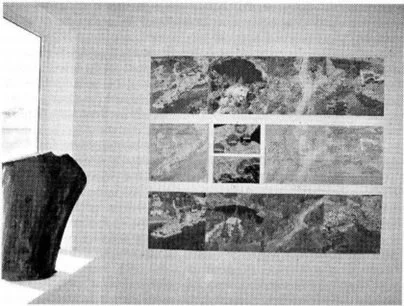
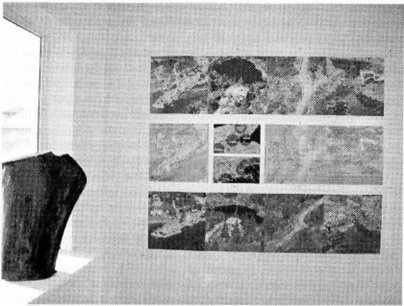
Fig. 4-3 Trigger Poillls Installation. Called to Action Art Sites Gallery. NY 2007, Aerial Photography tmder the direction of Aviva Rahmani, photographed by Ben Magro. Center images courtesy of Google Earth. Painted wood stumps and drawings by Aviva Rahmani.
As the locus of The Meat Piece was the chambers of a heart, the site of Blue Rocks was a place where the island geomorphology mimicked heart chambers surrounded by ocean. Blue Rocks consisted of painting seventy large glacial boulders blue, some more than 20 feet in diameter, along the degraded causeway. The local rocks embodied the spirit of the place with as much power as people. The vivid translucent color was a biodegradable slurry of buttermilk, moss, and pigment to grow more mosses. and elicited controversial attention. In the end. $500,000 of regional- and state-funded restoration, primarily from the U.S. Department of Agriculture brought back the wetlands and "flocks'' of eagles. Stay, Write, Look, Listen also recurred in 2002, flowering in a commission for Arts-In-Transit, in St. Louis, Missouri. St. Louis is built in a floodplain. But most landscaping there eschews local vegetation that might contain floodwaters. The Confluence plan. based on indigenous vegetation and rock fonnations. would have provided serenity and passive education, through out the year for passengers coming and going to the train station at the University of Missouri at St. Louis and provided ecological modeling. Designed as a "Trigger Point" landscape installation, Confluence created a continually changing, patterned color display of indigenous paintings and rocky outcroppings. Part of the pla1med installation was a series of duratrans, graphic displays in the train stations illustrating details of how the plan would evolve. On each poster was one of the four words: "Stay, Wait, Look (or) Listen." The proposal provided space for people to consider different regional land use strategies. Although unrealized, it further expanded my ideas about why, where and how a '·Trigger Point'' can be chosen and implemented.
Stay, Wait, look, listen is a message about nature. As a member of an impatient race, the mantra cautions me to be mindful, teaching me to carefully develop, fulfill. and observe change. Continued monitoring of the Ghost Nets site guides tbe C&Ol. But as with the consequences of human rape, at any given site, including Ghost Nets, it is unclear, once damage has occurred, whether recovery is fully possible.
111 the first decade of C&Ol, I began to question the extensive, exhausting traveling I was doing to achieve "ecological triage.'' Contemplating the devastating impact of Hurricane Katrina on New Orleans in 2005, provided my answer in 2006. I married technology to relational issues by inaugurating the first "Virtual Residency," as part of C&Ol.
Katrina was arguably the most frightening recent example of the effects of human degradation to. and poor housekeeping of, our ecology in American history. During the early summer of 2006, uneasy about a plan to physically visit three separate international sites to design environmental interventions, I designed a month-long Virtual Residency.28 Instead of engaging in jet travel around the globe, adding more carbon emissions to an already over-loaded earth, I stayed on my Maine island. From the Ghost Nets site, I studied and corresponded with other artists at the various locations I had planned to visit. I collected data on the problems at each site and compared them to each other. Accounts of that site work in Ghost Nets, New Dehli, India, Pescia, Italy, and Geumgang, Korea, and proposed interventions, were written about on my Web site blog. The resulting research, and observations about what was accomplished, including the work of the other on-site artists, was presented in two 16-hour "concerts." The Virtual Residency observed the circumpolar effects of global warming. It explored a model for "environmental triage," that did not spew jet fuel over the earth's waters as I traveled the globe to effect healing. The goal was to create an analog virtual community and culminate that in on-the-ground effects.
My Web site thus became a virtual Trigger Point, to engage broad participation in restoration areas, across great geographies. Arguably this was one more extrapolation of The Pocketbook Piece, the outgrowth of consciousness-raising more than three decades ago. This is the opposite model for action than that of the heroic individual acting upon the land or helpless human body of my girlhood. Rather, it represents a process of discovering experiential parallels and the means for inclusiveness.
My model for the Virtual Residency was in how terrorists have used the internet. If terrorists can use the net to cross boundaries to effect damage, then that tool of warfare can be re-tooled to effect peaceful solutions to ecological threat. The means I developed have continued as a series of "Virtual Concerts" online, conversations with international ecological art practitioners.29 The same means were then employed to attend conferences, as European Sociological Association (ESA) in Lueneburg, Germany; to establish a collaboration with Dr. Jim White, carbon emissions expert, interim director of the lnstaar Institute and chair of the Environmental Studies program at the University of Colorado, Boulder, Colorado, for Lucy Lippard's "Weather Changes" show on global warming at the Boulder Museum of Contemporary Art; and to participate in the 2007 Venice Biennale, as part of the Joseph Beuys' Social Sculpture event, "100 Days of Permanent Conference," with the international group, Cultura2 I, which emerged from ESA.
The models discussed, applied systems theory, to extrapolate from the experience of rape, a process of healing. Collectively, they represent a series of relational dialogues in time. The term ecofeminism has gone out of fashion. But this essay argues for reconsideration in a new light. The continuing rape of the earth horrifies most of us. Concern for this earth, the desire for innovative solutions that sustain her health as part of our own, are stronger than ever. Those concerns are grounded in real world issues. Scientists now project that hundreds of millions of people and countless other whole species of life will be casualties of weather changes by mid-century. We are already seeing that horror unfold. I have argued that we reconsider and recognize the validity of the metaphor of rape and recovery, as a paradigm for present-day ecological damage and repair. That conceptualization and manifestation points to a particular range of action: practical ecofeminism.
1 Rachel Carson, Silent Spring, (Boston: Houghton Mifflin; Cambridge. MA: Riverside Press, 1962). 1-3.
2 Mary Mellon. '·Gender and Environment:' in Ecofeminism and Globalization:
Exploring Culture, Context.and Religion, ed. Heather Eaton and Lois Ann Lorentzen. (Lanham. MD: Rowman and Littlefield Publishers, 2003), IJ-22.
3 Veranda Sheva, Water Wars: Privatization, Pollution and Profit, (Cambridge, MA: South End Press, 2002).
4 Weugaari Maathi was a founder of the Green Movement.
5 Nobel Prize Winner and Founder of the Green Belt Movement in Africa.
6 My understanding of Marcuse draws upon UCSD Philosophy lecture classes audited. readings and personal conversations: 1968-1972.
7 See Welton Jones. "Troupe At Synanon Plans Non-smooth Performance," San Diego Union, December 29. 1968.
8 "Nine Women," included Eleanor Antin. Ida Applebroog. Faiya Fredrnan, Patricia Patterson. Ellen van Fleet. Barbra Strasen. Martha Rosier. Judy Nikolaides, Joyce Cutler Shaw. and Aviva Rahmani.
9 http://www.ghostnets.com. Access date March 10. 2007.
10 Carolee Schneemann and Bruce R McPherson. More than Meat Joy: Performance Works and Selected Writings (New Paltz, NY: Documentext. 1979).
11 Alison Knowles, The House of Dust (Cologne: Gebr. Konig Verlag., 1968).
12 Diana Russell. The Secret Trauma: Incest i11 the lives of Girls and Women, 2nd ed. (New York: Basic Books/Perseus Press. 1999). 117-204.
13 The leading current author of this premise is Mark D. Bertness, Robert P. Brown Professor of Biology, Brown University. Mark D. Bertness, Atlantic Shorelines: Natural Hist01y and Ecology. (Princeton. NJ: Princeton University Press, 2007).
14 Ronald D. Laing. The Divided Self,(New York: Pantheon Books. 1969).
15 For further discussion. see the writings of Carey Lovelace and Vivien Greene Fryd. and art works by Vanessa Beecroft. Annie Sprinkle, and Barbara T. S111.itl1.
16 Nonna Broude, Mary D Garrard. and Judith K Brodsky, The Power of Feminist Art: The American Movement of the 1970s, history and impact (New York: H.N. Abrams. 1994). See also Rahmani and Montano, 1979.
17 See JiU Sebastian. "Review of Floating Worlds Revisited," New Art Examiner, November 12. 1982: Aviva Rahmani. ''The Floating Worlds Project,'' High Performance Magazine, June 1982. Issue 21. 44-9; Moira Roth, The Amazing Decade: Women and Pe,formance A,·t in America, /970-1980. (Los Angeles: Astro Artz, 1983): Arlene Raven, At Home, ex. cat., (Long Beach. CA: Long Beach Museum of Art. 1983); Aviva Rahmani, Floating Worlds. (Del Mar. CA: Internetwork Press. 1982): Elise Miller, "The Reproduction Dilemma," Artweek, (August 1982), 13, No. 27; Elise Miller, ''The Artist as Parent," San Diego Magazine, July 1982, 96-8.
18 Informed by studies with Native American Healers and conversations with Barbara T. Smith, then healing from her own rape. See Ruth Wallen. Review: ·'TI1e Medicine Wheel Murals" .33 (Spring 1986). 84.
19 Aviva Rahmani, "The Mental Technology ofREQlITEM" The Act 1989. 64-7.
20 Joseph Tallmer, "Artist's Ghost is a 9-year Hawit." New York Post (December 28, 1990): 44. Sue Spaid, (Sue Spaid and Amy Lipton. curators), Ecovention: Current Art to Transform Ecologies. (Cincinnati, OH: Contemporary Arts Center, 2002); A. Sutherland,·'Art-Eco on Vinalhaven," Maine Sunday Telegram, June JO, 200 I, E1-E2; Gloria Orenstein, "The Greening of Gaia: Ecofeminist Artists Revisit the Garden," Ethics and the Environment 8 no. I (Spring 2003): 103-11; Initiated by Hem1an Prigann, edited by Heike Strelow in co-operation with Vera David, Ecological Aesthetics: Art in Environmental Design: Theory and Practice (Basel: Birkiiuser Verlad fiir Arcllitek-tur, 2004): 196.
21 Gloria Orenstein. The Rejlowering of the Goddess. (New York: Pergamon Press, 1990); Gloria Orenstein and Irene Diamond. Rell'eaving the World: the Emergence of Ecofeminism (San Francisco: Sierra Club Books, 1990); Carolyn Merchant. Earthcare: Women and the Environment (New York: Routledge, 1996).
22 David Joselit. ·'Do Images Have a Gender?" Feedback: Television Against Democracy (Cambridge, MA: MIT Press, 2007).
23Aviva Rahmani et al, "TI1e Gulf of Maine Enviromental lnfonnation Exchange: participation. observation. conversation," Environment and Planning B: Planning and Design 28: 865-887. Online version available at http://www.commoncoordinates.com/papers/2001epbgominfoex.pdf. Access date March 10. 2007.
24 Women's Environmental Art Directory.
25 http://www.ecoartnetwork.org/membersLst.htmJ_. Access date March 10. 2007.
26 Part of the exhibit Site Specific curated by Pat Nick. "Why Blue Rocks?" http://greenmusemn.org/generic_content.php?ct_id=9I. Access date March I0, 2007.
27 GIS is Geographic lnfonnation Systems, see http://erg.usgs.gov/isb/pubs/gis_poster/ Access date March 10, 2007. 28 ·'Birthing a Virtual Residency;'
http://greenmuseum.org/generic_content.php?ct_id=268. Access date March I0. 2007.
29 Aviva Ralunani Ghost Nets Virtual Concerts. TalkShoe Chime In http://www.talkshoe.com/talkshoe/web/talkCast.jsp?masterid=1210&cmd=tc. Web site Jawich date Jtme 15, 2006.
References
Bertness, Mark 0. Atlantic Shorelines: Natural Histo,y and Ecology.
Princeton, NJ: Princeton University Press, 2007.
Broude, Norma, Mary Garrard, and Judith Brodsky. The Power of Feminist Art: The American Movement of the 1970s, Histo,y and Impact. New York: H.N. Abrams, 2004.
Bumham, Linda and Linda Montano. "Saving the Moment: Aviva Rahmani," High Pe,formance Magazine 2 no. 3: p. 68-9
Carson, Rachel. Silent Spring. Boston: Houghton Mifflin; Cambridge, MA: Riverside Press, 1962.
Eaton, Heather and Lois Ann Lorentzen. Ecofeminism and Globalization: Exploring Culture, Context, and Religion. Lanham, MD: Rowman and Littlefield Publishers, 2003.
Joselit, David. "Do Images Have a Gender?" Feedback: Television against democracy. Cambridge, .MA: MlT Press, 2007.
Knowles, Alison. The House of Dust. Cologne: Gebr. Konig Verlag, 1968. Laing, Ronald D. The Divided Self New York: Pantheon Books, 1969.
McDonald, Robert. "At the Galleries." Los Angeles Times (November 22, 1985)
Merchant, Caroly. Earthcare: Women and the Environment. New York: Routledge, 1996.
Oilman, Leah. 1989. "Grief and Joy Unfold in Performance." Los Angeles Times (September 8, 1989): p. 21.
Orenstein, Gloria. 2003. "The Greening of Gaia: Ecofeminist Artists Revisit the Garden." Ethics and the Environment 8 no. I (Spring 2003): I03-11.
--. The Rejlowering of the Goddess. New York: Pergamon Press, 1990. Orenstein Gloria and Irene Diamond. Reweaving the World: the Emergence of Ecofeminism. San Francisco: Sierra Club Books, 1990. Prigann, Herman, Heike Strelow. and Vera David. Aesthetics of Ecology:
Art in Environmental Design: Theory and Practice. Basel: Birkauser Verlad fiir Architektur, 2004.
Rahmani. Aviva. "Birthing a Virtual Residency'' http://greenmuseum.org/generic_content.php?ct_id=268
--:'The Mental Technology of REQUIEM." The Act, Vol. 2/No. I 1989. 64-67.
Rahmani, Aviva, Paul Schroeder, Paul Boudreau, Chris Brehme, Andrew Boyce, and Alison Evans. 2001. ''The Gulf of Maine Environmental Information Exchange: Participation, Observation, Conversation." Environment and Planning B: Planning and Design 28: 865-87.
Russell, Diana E.H. The Secret Trauma: Incest in the Lives of Girls and Women. 2nd ed. New York: Basic Books/Perseus Press, 1999.
Schneemann, Carolee. More than Meat Joy: Pe,formance Works and Selected Writings. New Paltz, NY: Documentext, 1979.
Spaid, Sue. (Sue Spaid and Amy Lipton, curators) Ecovention: Current Art to Transform Ecologies. Cincirmati, OH: Contemporary Arts Center, 2002.
Sutherland, Ann. "Art-Eco on Vinalhaven," Maine Sunday Telegram, June 10, 2001. El-E2.
Tallmer, Jerry. "Artist's Ghost is a 9-year Haunt." New York Post, December 28, 1990. 44.
Wallen, Ruth. "Review: The Medicine Wheel Mural." High Performance 33 (1986), 84.